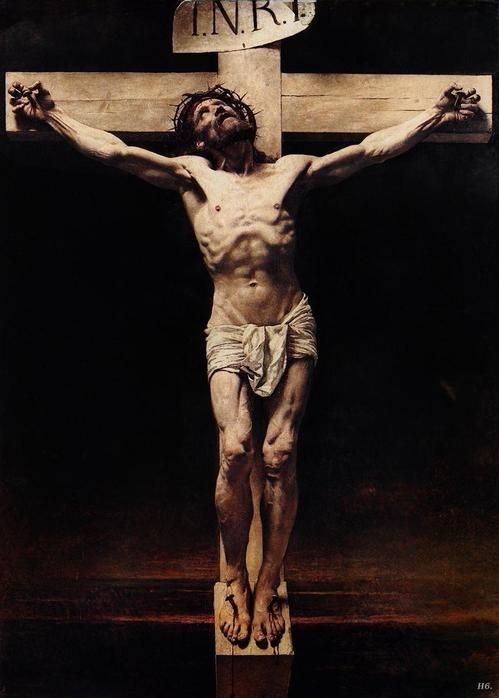

The following passage by Dietrich Bonhoeffer is from his book, part of the last chapter, in The Cost of Discipleship.
It is the truest and most profound theology, a theology of the cross, the theology of “Christ in us the hope of glory”, a theology of Emmanuel, the incarnate Lord Jesus Christ who is “God with us”.
It is a theology of the one true God who has hidden Himself in his one and only Son, hidden that we might see Him as He is.
Bonhoeffer:
“The form of Christ on earth is the form of the death of the crucified one. The image of God is the image of Jesus Christ on the cross. It is into this image that the disciple’s life must be transformed. It is a life in the image and likeness of Christ’s death (Phil. 3:10; Rom. 6:4f.). It is a crucified life (Gal. 2:19). In baptism Christ engraves the form of death on his own. Having died to the flesh and to sin, Christians are now dead to this world, and the world is dead for them (Gal. 6:14) . Those who live out of their baptism live out of their death. Christ marks the life of his own with their daily dying in the struggle of the spirit against the flesh, and with their daily suffering the pains of death which the devil inflicts on Christians. It is the suffering of none other than Jesus Christ that all of his disciples on earth have to endure. Christ honors only a few of his followers with being in the most intimate community with his suffering, that is, with martyrdom. It is here that the life of the disciple is most profoundly identical with the likeness of Jesus Christ’s form of death.
It is by Christians’ being publicly disgraced, having to suffer and being put to death for the sake of Christ, that Christ himself attains visible form within his community. However, from baptism all the way to martyrdom, it is the same suffering and the same death. It is the new creation of the image of God through the crucified one. All those who remain in community with the incarnate and crucified one and in whom he gained his form will also become like the glorified and risen one. “We will bear the image of the heavenly human being” (1 Cor. 15:49).783 “We will be like him, for we will behold him as he is” (1 John 3:2). The image of the risen one will transform those who look at it in the same way as the image of the crucified one. Those who behold Christ are being drawn into Christ’s image, changed into the likeness of Christ’s form. Indeed, they become mirrors of the divine image. Already on this earth we will reflect the glory of Jesus Christ. The brilliant light and the life of the risen one will already shine forth from the form of death of the crucified one in which we live, in the form of sorrow and cross. The transformation into the divine image will become ever more profound, and the image of Christ in us will continue to increase in clarity. This is a progression in us from one level of understanding to another and from one degree of clarity to another, toward an ever-increasing perfection in the form of likeness to the image of the Son of God. “And all of us, who with unveiled faces let the glory of the Lord be reflected in us, are thereby transformed into his image from glory to glory” (2 Cor. 3:18). This is the indwelling of Jesus Christ in our hearts. The life of Jesus Christ here on earth has not yet concluded. Christ continues to live it in the lives of his followers. To describe this reality we must not speak about our Christian life but about the true life of Jesus Christ in us. “It is no longer I who live, but it is Christ who lives in me” (Gal. 2:20). The incarnate, crucified, and transfigured one has entered into me and lives my life. “Christ is my life” (Phil. 1:21).786 But together with Christ, the Father also dwells in me; and both Father and Son dwell in me through the Holy Spirit. It is indeed the holy Trinity who dwells within Christians, who permeates them and changes them into the very image of the triune God. The incarnate, the crucified, and the transfigured Christ takes on form in individuals because they are members of his body, the church. The church bears the incarnate, crucified, and risen form of Jesus Christ. The church is, first of all, Christ’s image (Eph. 4:24; Col. 3:10), and through the church so too are all its members the image of Christ. Within the body of Christ we have become “like Christ.” It now becomes understandable that the New Testament calls us again and again to be “like Christ” (καθὼς XρισƬός). We are to be like Christ because we have already been shaped into the image of Christ. Only because we bear Christ’s image already can Christ be the “example” whom we follow. Only because he himself already lives his true life in us can we “walk just as he walked” (1 John 2:6), “act as he acted” (John 13:15), “love as he loved” (Eph. 5:2; John 13:34; 15:12), “forgive as he forgave” (Col. 3:13), “have the same mind that was in Jesus Christ” (Phil. 2:5), follow the example he left for us (1 Peter 2:21), and lose our lives for the sake of our brothers and sisters, just as he lost his life for our sake (1 John 3:16). Only because he was as we are can we be as he was. Only because we already are made like him can we be “like Christ.” Since we have been formed in the image of Christ, we can live following his example. On this basis, we are now actually able to do those deeds, and in the simplicity of discipleship, to live life in the likeness of Christ. Here simple obedience to the word takes place. I no longer cast even a single glance on my own life, on the new image I bear. For in the same moment that I would desire to see it, I would lose it. For it is, of course, merely the mirror reflection of the image of Jesus Christ upon which I look without ceasing. The followers look only to the one whom they follow. But now the final word about those who as disciples bear the image of the incarnate, crucified, and risen Jesus Christ, and who have been transformed into the image of God, is that they are called to be “imitators of God.” The follower of Jesus is the imitator of God. “Therefore be imitators of God, as beloved children” (Eph. 5:1).

 Crucified Hearts
Leave a comment