-
New Vlog On My Channel
-
Christian Morality and the Righteousness of Christ
Christian morality is rooted in the character of God as revealed in Christ. It is not an achievement by which we are considered righteous, rather, it is the fruit that is born by those who are already righteous through faith in the blood of Christ. To act right we must first be right with God. And being right with God, being justified and reconciled to him, is by faith alone.
Christian morality is of great value in the world, it is of great value with God, as it is founded on the laws of his kingdom, however, such morality is only possible in the Christian life through the imputed righteousness of Christ and indwelling of the Holy Spirit that we receive when we are justified by faith in Christ’s atonement for our sins. His perfect righteousness is “credited” to us to through faith alone (Rom. 4). We are acquitted of our sins as long as we continue to exercise faith in his act of acquittal at the cross (Rom. 3.19-31). We are justified by faith without works of the law. Therefore, no human being can boast of righteousness except in the cross of Christ our Lord.
Because we receive the Holy Spirit at baptism, in it being conformed to his death and his resurrection through faith (Rom. 6), we begin growing in the moral life, what the Bible calls sanctification or holiness. This is the work of a lifetime as we will always have inclinations and propensities towards sin to combat and overcome by the grace of God. There’s never a time when we can say we have arrived at perfection and yet we strive for being complete in the love of God toward our neighbors.
The following scripture describes such Christian morality. Living this life is evidence of the faith that we profess in the righteousness of Christ. May we ever go on from grace to grace, His image, the image of Christ crucified, formed in us.
If there were no danger of falling away from grace, no danger, even daily, of straying from the morality of Christ, then such instruction would be superfluous. But in fact, the apostle Paul urges a life of continuing growth and obedience in Christ lest we stray again like sheep who wander away from the shepherd.
Ephesians 4:17-32 NASB
“So this I say, and affirm together with the Lord, that you walk no longer just as the Gentiles also walk, in the futility of their mind, being darkened in their understanding, excluded from the life of God because of the ignorance that is in them, because of the hardness of their heart; and they, having become callous, have given themselves over to sensuality for the practice of every kind of impurity with greediness.
But you did not learn Christ in this way, if indeed you have heard Him and have been taught in Him, just as truth is in Jesus, that, in reference to your former manner of life, you lay aside the old self, which is being corrupted in accordance with the lusts of deceit, and that you be renewed in the spirit of your mind, and put on the new self, which in the likeness of God has been created in righteousness and holiness of the truth.
Therefore, laying aside falsehood, speak truth each one of you with his neighbor, for we are members of one another. Be angry, and yet do not sin; do not let the sun go down on your anger, and do not give the devil an opportunity. He who steals must steal no longer; but rather he must labor, performing with his own hands what is good, so that he will have something to share with one who has need. Let no unwholesome word proceed from your mouth, but only such a word as is good for edification according to the need of the moment, so that it will give grace to those who hear. Do not grieve the Holy Spirit of God, by whom you were sealed for the day of redemption. Let all bitterness and wrath and anger and clamor and slander be put away from you, along with all malice. Be kind to one another, tender-hearted, forgiving each other, just as God in Christ also has forgiven you.
— Ephesians 4:17-32 -
Test Post Using Open Live Writer On My New Laptop
I recently bought a new Acer Swift 3 laptop to replace my aging Macbook Pro. It has better specs for the money, though I am just now returning to a Windows platform for the first time in twenty years. My Macbook battery had aged out in its charging cycles by almost half again what was recommended. Not only did I have little battery life after charging, but I was afraid it would crash and I would lose my files. I’ll miss some of the software that is only available in the Apple universe, but it can’t be helped, at least for now.
My new Acer has 1 TB of SSD storage and 16 GB of ram. I can’t imagine I’ll need more than that, but the laptop is more easily upgraded than a Mac. I am getting use to the different feel of the keyboard and the placement of some of the keys and their functions. Battery life is great, a full days worth in my workflow. (I am not gaming). The OLED screen is bright and crisp for my old eyes. No regrets on the purchase, which I made on Amazon with 12 months of payments at no interest. Total with tax was just over a thousand dollars. A new Macbook with these specs would be more than twice that.
I guess I am ready to upload what I’ve written using Open Live Writer. Here goes. -
Heart Matters
“What the heart loves, the will chooses and the mind justifies.”
~ Ashley Null, in Thomas Cranmer’s Doctrine of Repentance: Renewing the Power to Love
Therefor, we cannot follow the natural heart, but what God has revealed in his word.
Since…
“The heart is more deceitful than all else
And is desperately sick;
Who can understand it?
“I, the Lord, search the heart,
I test the mind,
Even to give to each man according to his ways,
According to the results of his deeds.
— Jeremiah 17:9-10As Jesus warned:
“That which proceeds out of the man, that is what defiles the man. For from within, out of the heart of men, proceed the evil thoughts, fornications, thefts, murders, adulteries, deeds of coveting and wickedness, as well as deceit, sensuality, envy, slander, pride and foolishness. All these evil things proceed from within and defile the man.”
— Mark 7:20-23Because, “What the heart loves, the will chooses and the mind justifies”, our heart must be renewed by the regenerating and indwelling power of the Holy Spirit. Our hearts are only a safe God when under the control of God’s word, Christ himself being that Word of life and light.
We are only safe in giving our hearts to Jesus.
Therefore,
“Let the peace of Christ rule in your hearts, to which indeed you were called in one body; and be thankful. Let the word of Christ richly dwell within you, with all wisdom teaching and admonishing one another with psalms and hymns and spiritual songs, singing with thankfulness in your hearts to God. Whatever you do in word or deed, do all in the name of the Lord Jesus, giving thanks through Him to God the Father.”
— Colossians 3:15-17For the word of God is living and active and sharper than any two-edged sword, and piercing as far as the division of soul and spirit, of both joints and marrow, and able to judge the thoughts and intentions of the heart.
— Hebrews 4:12 -
Slaves, Priest, Kings of Blood
Christ has purchased us with his own blood. By paying the redemption price, to set us free from our slavery to sin, He has reconciled us to God. “You were bought with a price; do not become slaves of men.” (1 Cor. 7:23)
Again it is said: “For you have been bought with a price: therefore glorify God in your body. (1 Cor. 6:20)
Of course, this is the great offense of the cross, that human beings who themselves long to be served as gods, must acknowledge that they are dependent mortal creatures who can only have life and light by acknowledging their true identity under God. We were bought to become slaves of righteousness (Rom. 6.16-20).
We who love to boast, who crave the spotlight and applause, to be petted and adored, are offended by the honor and glory extended to him who took the lowest place among us, the divine King becoming a Servant of servants. It is the essence of human hubris, this blindness to the divine humility which says the first shall be last and the last shall be first.
How do we not see that he who humbled himself in obedience, even the death on a cross, substituting himself as a sacrifice for our sins, should not be exalted above us? Why do we withhold from him our obedience and adoration, why does it offend us that every knee should bow at the name that is above every other name, the name of Jesus? (Phil. 2.5-11)
Does this offend you?
“Which of you, having a slave plowing or tending sheep, will say to him when he has come in from the field, ‘Come immediately and sit down to eat’? But will he not say to him, ‘Prepare something for me to eat, and properly clothe yourself and serve me while I eat and drink; and afterward you may eat and drink’? He does not thank the slave because he did the things which were commanded, does he? So you too, when you do all the things which are commanded you, say, ‘We are unworthy slaves; we have done only that which we ought to have done.’”
— Luke 17:7-10
Heaven is not offended.
Nor should we forget that the image we bear on earth will be exchanged for a new image in heaven, made in his likeness as priests and kings. If we have born with him in his suffering here we will bear glory with him in the age to come.
“…and if children, heirs also, heirs of God and fellow heirs with Christ, if indeed we suffer with Him so that we may also be glorified with Him.”
— Romans 8:17
This too is part of our wonderful redemption by his blood. Let us sing with the angels this song of praise.
“And they sang a new song, saying,
“Worthy are You to take the book and to break its seals; for You were slain, and purchased for God with Your blood men from every tribe and tongue and people and nation.
“You have made them to be a kingdom and priests to our God; and they will reign upon the earth.”
— Revelation 5:9-10 -
New Vlog: Simply For You
I hope you can click and subscribe on YouTube. -
Who Am I? Who Am I Becoming?
“At every moment you choose yourself. But do you choose your self? Body and soul contain a thousand possibilities out of which you can build many I’s. But in only one of them is there a congruence of the elector and the elected. Only one—which you will never find until you have excluded all those superficial and fleeting possibilities of being and doing with which you toy, out of curiosity or wonder or greed, and which hinder you from casting anchor in the experience of the mystery of life, and the consciousness of the talent entrusted to you which is your I.”
– Dag Hammarskjöld, Markings, p.19Here are a few quotes to consider about the identity of self through a Christian lens, some things about our ever-changing identity in relation to others and to God.
“Then God said, “Let Us make man in Our image…”
Gen. 1.26
“Therefore be imitators of God, as beloved children…”
— Ephesians 5:1
“What we all need is authenticity of being, that we live in accord with our true selves, not just the self we think we want to be but the self God calls us to be. Knowing who we are is not something we acquire by ourselves. We know ourselves only by knowing our God. Knowing ourselves is less important than knowing who made us, calls us, goes with us, and knows us. Peace cannot be found anywhere else.”
Klyne R. Snodgrass
“Beloved, now we are children of God, and it has not appeared as yet what we will be. We know that when He appears, we will be like Him, because we will see Him just as He is. And everyone who has this hope fixed on Him purifies himself, just as He is pure.”
— 1 John 3:2-3
“As obedient children, do not be conformed to the former lusts which were yours in your ignorance, but like the Holy One who called you, be holy yourselves also in all your behavior; because it is written, “You shall be holy, for I am holy.”
— 1 Peter 1:14-16
“Here is the really crucial point. You do choose yourself, even though it is only in the context of the givens of your life. Yes, there is the huge debate about your ability to choose, the limits to your ability to choose caused by sin, hardwiring, and other people’s sins and inabilities, but you still choose yourself. You did not choose to be born, your family of origin, or where you were born. You do choose if you will stay where you were born and how you will handle relations, even messy family relations. You choose whether you will be honest with yourself about yourself and whether you are willing to be displeasing to yourself in order to become what you should be. You choose whether you will be honest about and examine the society of which you are a part. You choose to accept or reject illusion. You choose whether you will live an unexamined life. You choose whether you will take responsibility for your actions. You choose how you will handle your urges and desires, especially your anger and your sexuality. You choose whether you will give attention to and love God and God’s will or whether you will ignore God’s intent for your life and go your own way. You choose how and where you will invest yourself and what interests you will pursue, whether your life will focus on really important issues and relations or on temporary pleasure. You choose whether you will be self-centered. You choose whether you will invest in your own learning and hold yourself accountable for learning. You choose the people you allow to be models and mentors of your life. You choose whether you will have good will toward people, even if they do not deserve it. You choose how you will react to injustice. You choose whether you will live from a sense of entitlement and privilege, so that you do not function from any sense of justice and fairness. You choose whether you will blame other people for your failures and all that is wrong in life. You choose how you treat people. You choose what kinds of attitudes characterize your life. You choose how you will steward your body and to what kinds of abuses and dangers you expose it. You choose the communities—or at least some of them—that you allow to tell you who you are and that will be formative in shaping you.”
– Klyne R. Snodgrass
“For those whom He foreknew, He also predestined to become conformed to the image of His Son, so that He would be the firstborn among many brethren…”
— Romans 8:29
Who Am I? by Deitrich Bonhoeffer
Who am I? They often tell me
I stepped from my cells confinement
Calmly, cheerfully, firmly,
Like a Squire from his country house.
Who am I? They often tell me
I used to speak to my warders
Freely and friendly and clearly,
As thought it were mine to command.
Who am I? They also tell me
I bore the days of misfortune
Equably, smilingly, proudly,
like one accustomed to win.
Am I then really that which other men tell of?
Or am I only what I myself know of myself?
Restless and longing and sick, like a bird in a cage,
Struggling for breath, as though hands were compressing my throat,
Yearning for colors, for flowers, for the voices of birds,
Thirsting for words of kindness, for neighborliness,
Tossing in expectations of great events,
Powerlessly trembling for friends at an infinite distance,
Weary and empty at praying, at thinking, at making,
Faint, and ready to say farewell to it all.
Who am I? This or the Other?
Am I one person today and tomorrow another?
Am I both at once? A hypocrite before others,
And before myself a contemptible woebegone weakling?
Or is something within me still like a beaten army
Fleeing in disorder from victory already achieved?
Who am I? They mock me, these lonely questions of mine.
Whoever I am, Thou knowest, O God, I am thine!
“Just as we have borne the image of the earthy, we will also bear the image of the heavenly.”
— 1 Corinthians 15:49 -
My new video… For those who suffer and are afraid
Thus says the Lord to Cyrus His anointed,
Whom I have taken by the right hand,
To subdue nations before him
And to loose the loins of kings;
To open doors before him so that gates will not be shut: “I will go before you and make the rough places smooth;
I will shatter the doors of bronze and cut through their iron bars. “I will give you the treasures of darkness
And hidden wealth of secret places,
So that you may know that it is I,
The Lord, the God of Israel, who calls you by your name. “For the sake of Jacob My servant,
And Israel My chosen one,
I have also called you by your name;
I have given you a title of honor
Though you have not known Me. “I am the Lord, and there is no other;
Besides Me there is no God.
I will gird you, though you have not known Me…Isaiah 45 1- 5
-
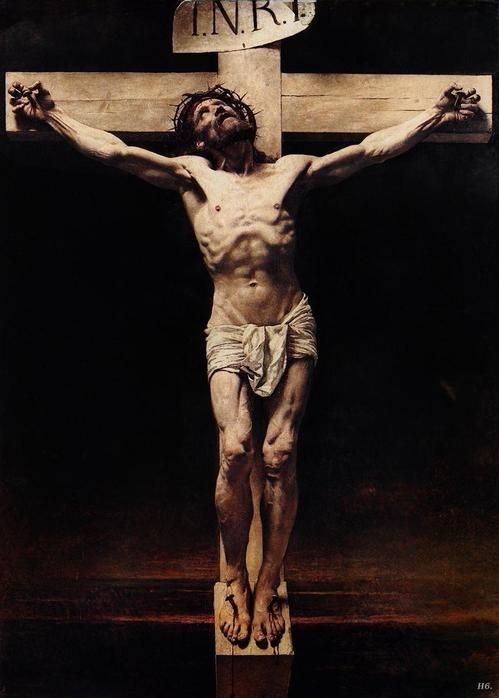
Bonhoeffer: The Image of God is Christ Crucified

The following passage by Dietrich Bonhoeffer is from his book, part of the last chapter, in The Cost of Discipleship.
It is the truest and most profound theology, a theology of the cross, the theology of “Christ in us the hope of glory”, a theology of Emmanuel, the incarnate Lord Jesus Christ who is “God with us”.
It is a theology of the one true God who has hidden Himself in his one and only Son, hidden that we might see Him as He is.
Bonhoeffer:
“The form of Christ on earth is the form of the death of the crucified one. The image of God is the image of Jesus Christ on the cross. It is into this image that the disciple’s life must be transformed. It is a life in the image and likeness of Christ’s death (Phil. 3:10; Rom. 6:4f.). It is a crucified life (Gal. 2:19). In baptism Christ engraves the form of death on his own. Having died to the flesh and to sin, Christians are now dead to this world, and the world is dead for them (Gal. 6:14) . Those who live out of their baptism live out of their death. Christ marks the life of his own with their daily dying in the struggle of the spirit against the flesh, and with their daily suffering the pains of death which the devil inflicts on Christians. It is the suffering of none other than Jesus Christ that all of his disciples on earth have to endure. Christ honors only a few of his followers with being in the most intimate community with his suffering, that is, with martyrdom. It is here that the life of the disciple is most profoundly identical with the likeness of Jesus Christ’s form of death.
It is by Christians’ being publicly disgraced, having to suffer and being put to death for the sake of Christ, that Christ himself attains visible form within his community. However, from baptism all the way to martyrdom, it is the same suffering and the same death. It is the new creation of the image of God through the crucified one. All those who remain in community with the incarnate and crucified one and in whom he gained his form will also become like the glorified and risen one. “We will bear the image of the heavenly human being” (1 Cor. 15:49).783 “We will be like him, for we will behold him as he is” (1 John 3:2). The image of the risen one will transform those who look at it in the same way as the image of the crucified one. Those who behold Christ are being drawn into Christ’s image, changed into the likeness of Christ’s form. Indeed, they become mirrors of the divine image. Already on this earth we will reflect the glory of Jesus Christ. The brilliant light and the life of the risen one will already shine forth from the form of death of the crucified one in which we live, in the form of sorrow and cross. The transformation into the divine image will become ever more profound, and the image of Christ in us will continue to increase in clarity. This is a progression in us from one level of understanding to another and from one degree of clarity to another, toward an ever-increasing perfection in the form of likeness to the image of the Son of God. “And all of us, who with unveiled faces let the glory of the Lord be reflected in us, are thereby transformed into his image from glory to glory” (2 Cor. 3:18). This is the indwelling of Jesus Christ in our hearts. The life of Jesus Christ here on earth has not yet concluded. Christ continues to live it in the lives of his followers. To describe this reality we must not speak about our Christian life but about the true life of Jesus Christ in us. “It is no longer I who live, but it is Christ who lives in me” (Gal. 2:20). The incarnate, crucified, and transfigured one has entered into me and lives my life. “Christ is my life” (Phil. 1:21).786 But together with Christ, the Father also dwells in me; and both Father and Son dwell in me through the Holy Spirit. It is indeed the holy Trinity who dwells within Christians, who permeates them and changes them into the very image of the triune God. The incarnate, the crucified, and the transfigured Christ takes on form in individuals because they are members of his body, the church. The church bears the incarnate, crucified, and risen form of Jesus Christ. The church is, first of all, Christ’s image (Eph. 4:24; Col. 3:10), and through the church so too are all its members the image of Christ. Within the body of Christ we have become “like Christ.” It now becomes understandable that the New Testament calls us again and again to be “like Christ” (καθὼς XρισƬός). We are to be like Christ because we have already been shaped into the image of Christ. Only because we bear Christ’s image already can Christ be the “example” whom we follow. Only because he himself already lives his true life in us can we “walk just as he walked” (1 John 2:6), “act as he acted” (John 13:15), “love as he loved” (Eph. 5:2; John 13:34; 15:12), “forgive as he forgave” (Col. 3:13), “have the same mind that was in Jesus Christ” (Phil. 2:5), follow the example he left for us (1 Peter 2:21), and lose our lives for the sake of our brothers and sisters, just as he lost his life for our sake (1 John 3:16). Only because he was as we are can we be as he was. Only because we already are made like him can we be “like Christ.” Since we have been formed in the image of Christ, we can live following his example. On this basis, we are now actually able to do those deeds, and in the simplicity of discipleship, to live life in the likeness of Christ. Here simple obedience to the word takes place. I no longer cast even a single glance on my own life, on the new image I bear. For in the same moment that I would desire to see it, I would lose it. For it is, of course, merely the mirror reflection of the image of Jesus Christ upon which I look without ceasing. The followers look only to the one whom they follow. But now the final word about those who as disciples bear the image of the incarnate, crucified, and risen Jesus Christ, and who have been transformed into the image of God, is that they are called to be “imitators of God.” The follower of Jesus is the imitator of God. “Therefore be imitators of God, as beloved children” (Eph. 5:1).
Home
About Me
A Christian, thinking, vlogging, and writing online. I live elsewhere as well. I follow the theology of the cross in the faith and practice of the Seventh-day Adventist Church. Formerly a pastor in Europe and America, now living semi-retired in Kentucky (U.S.), driving for the Amish and in-home carer.

